ConstructConnect Conversion Optimization
A landing page program rebuilt around closed revenue instead of form fills, worth more than $5.5MM in incremental ARR.
- Company
-

- Role
- Led demand generation and conversion strategy, and the team executing it
- Timeframe
- 2019 to 2020
- Surfaces
- Paid search, email, and in-product landing pages
$3.1MM
Incremental ARR from paid search campaigns.
$2.5MM
Incremental ARR from email campaigns.
6.5x
Increase in product-qualified leads.
22.6%
Conversion rate on the winning paid search page.
The situation
Five acquired brands, five different ideas of what a good landing page was.
ConstructConnect was assembled out of acquisitions. Construction Data, iSqFt, PlanSwift, SmartBid, and On Center each arrived with their own landing pages, their own ad accounts, and their own house style. Paid search and email were running against all of them at once.
Every one of those pages reported a conversion rate, and the conversion rates looked fine. What nobody could answer was which pages produced revenue. A page converting at 30 percent into deals that never closed was quietly costing more than a page converting at 8 percent into signed contracts. The reporting had no way to tell the two apart.
The approach
Audit everything, find where conversion breaks, then test.
Audit every live landing page against revenue
The first job was a full inventory and audit. Every landing page attached to any campaign in flight was pulled into one comprehensive analysis covering paid search, email, and the product itself, then scored on four numbers that chain together: form-fills (MQLs), opportunities created (SQLs), closed-won deals, and average contract value (ACV).
By scoring on all four numbers, we changed the assessment for what counts as a winner. A page is only worth its traffic if the leads it produces generate dollars, so pages were ranked on what they contributed at the bottom of the funnel, rather than the top.
- 01 Form-fills Marketing-qualified leads. The only number most landing page reporting ever showed.
- 02 Opportunities Sales-qualified leads. The first point where a page's traffic proves it was worth buying.
- 03 Closed-won deals Signed contracts traced back to the page that produced the lead.
- 04 Average contract value What those deals were actually worth, which is where pages were finally ranked.
Every live page across paid search, in-product, and email was scored on the same chain, so they could finally be compared to each other. A page converting at 30 percent into deals that never closed ranked below a page converting at 8 percent into signed contracts.
Find where conversion broke
With every page on one scale, the patterns separated quickly and easily. Each channel was losing conversion for a different reason, which meant each one required a different fix.
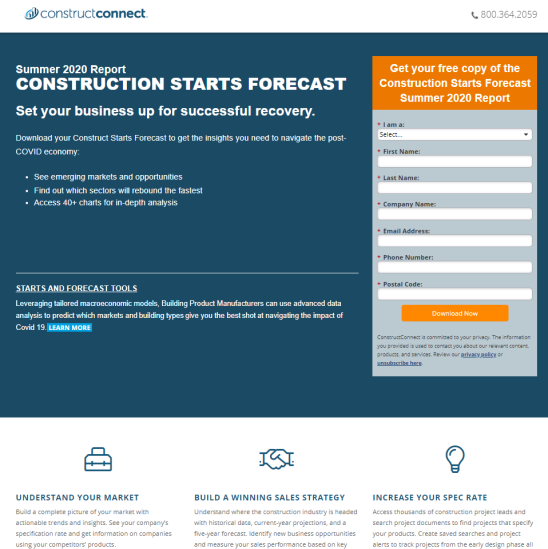
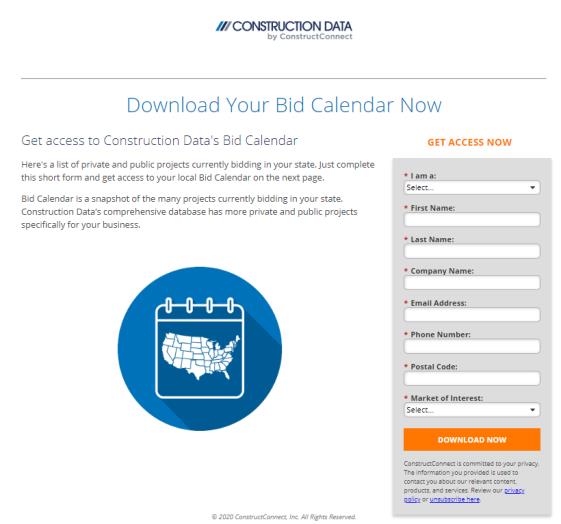
Email landing pages converted in proportion to what they gave the reader in return. The two best pages both handed over a concrete asset, a construction starts forecast and a regional bid calendar. The weakest pages asked for a form and offered a description of the product in return.
Email landing pages by conversion rate
Percentage of visitors who completed the form. All three charts on this page share a 0 to 40 percent scale.
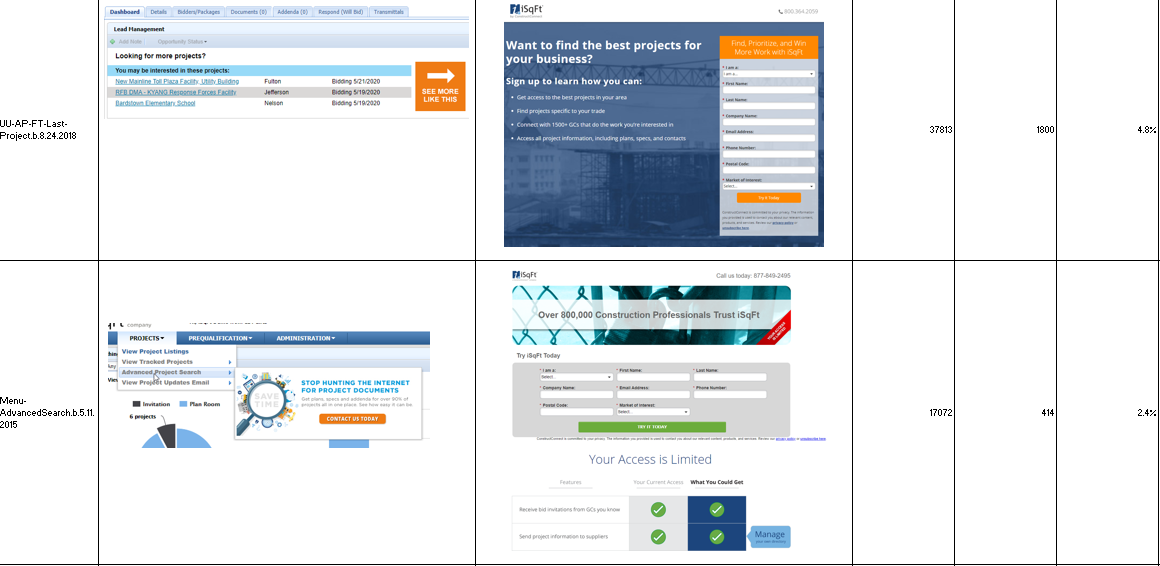
In the product, placement mattered more than wording. A contextual call to action served inside the tool at the moment someone hit a limit converted at 29.7 percent. The same offer on a standalone upsell page converted at 6.4 percent. The “where” and the “when” proved to be much more impactful than the “what”.
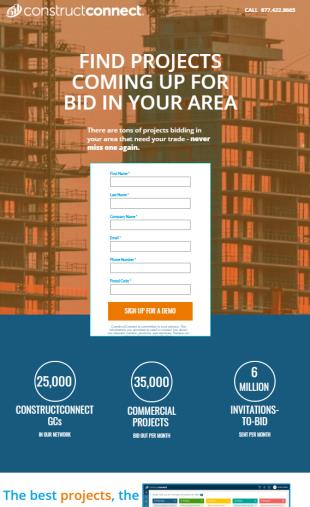
Paid search was losing conversion in the gap between the initial ad a user saw and the landing page they hit after a click. Ads written for one legacy brand pointed at pages carrying a different brand's promise, and the visitor had to reconcile the two (which, more often than not, resulted in a bounce). The pages that matched their ads converted at roughly double the rate of the ones that did not.
In-product landing pages
Same offer, two placements.
Paid search landing pages
Message match between ad and page.
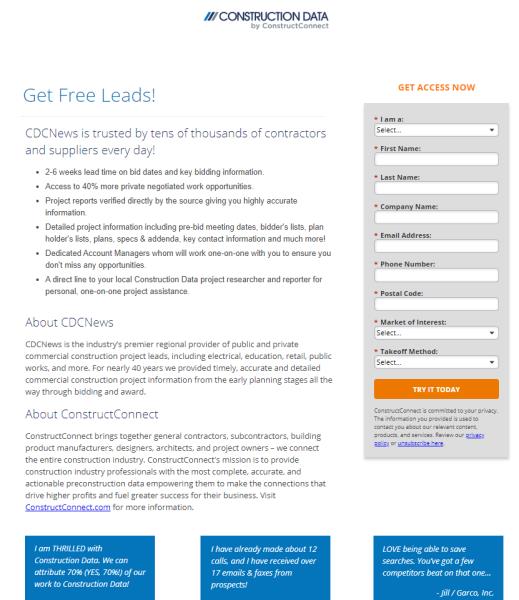
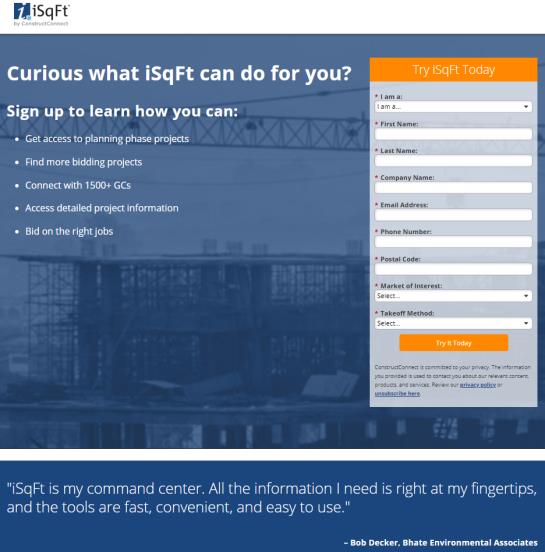
Testing paid search landing pages four ways at once
The audit said message match was worth roughly double the conversion rate. The next question was: which message? Rather than run one change at a time, the winning paid search page was built four ways across two variables. A benefit headline against a question headline, and a cool image treatment against a warm one.
All four ran simultaneously through Unbounce Smart Traffic, which routes each visitor to the variant most likely to convert them rather than splitting traffic evenly and waiting for one winner. Across 3,651 visitors the combined page converted at 22.6 percent, and the routing itself added 184 conversions over an even split.
Diagrams of the four live variants. Each ran the same form and the same social proof, varying only headline strategy and image treatment.
- 3,651
- Visitors
- 825
- Conversions
- 22.6%
- Conversion rate
- +184
- Conversions added by smart routing
Unbounce reported the routing itself as a 40.62 percent lift over an even traffic split.
The results
What the program returned.
-
$3.1MM
Increase in ARR from paid search campaigns.
-
$2.5MM
Increase in ARR from email campaigns.
-
200%
Increase in conversion rate on the strongest paid search landing pages.
-
32%
Increase in email marketing conversion rates.
-
6.5x
Increase in product-qualified leads.
-
$5.6MM
Combined incremental ARR across both channels.
Tim successfully drove large volume demand generation for a significant portion of the business, in addition to leading others on the team. He has a strong command over many marketing disciplines with an emphasis on digital marketing.
Former Chief Marketing Officer, ConstructConnect
Built with