Repositioning Agolo as Implicit
Agolo sold GraphRAG infrastructure to data science teams, the group most likely to build it themselves. A rebrand, a new category, and three specific verticals later, qualified leads went from 1 per quarter to 1,133.
- Company
-

- Role
- Led the rebrand and repositioning, naming through go-to-market
- Timeframe
- Q4 2024 to Q2 2026
- Scope
- Naming, brand identity, positioning, messaging, and web
from 1 a quarter
1,133
Qualified leads in Q2 2026, against one in the quarter before the rebrand.
62
Qualified leads in the first full quarter as Implicit.
3
Verticals identified, from 8 options, after pivoting and re-positioning 3 times.
100%
Share of commercial customers won as Implicit. None closed under Agolo.
The situation
Selling the architecture to the people most likely to build it.
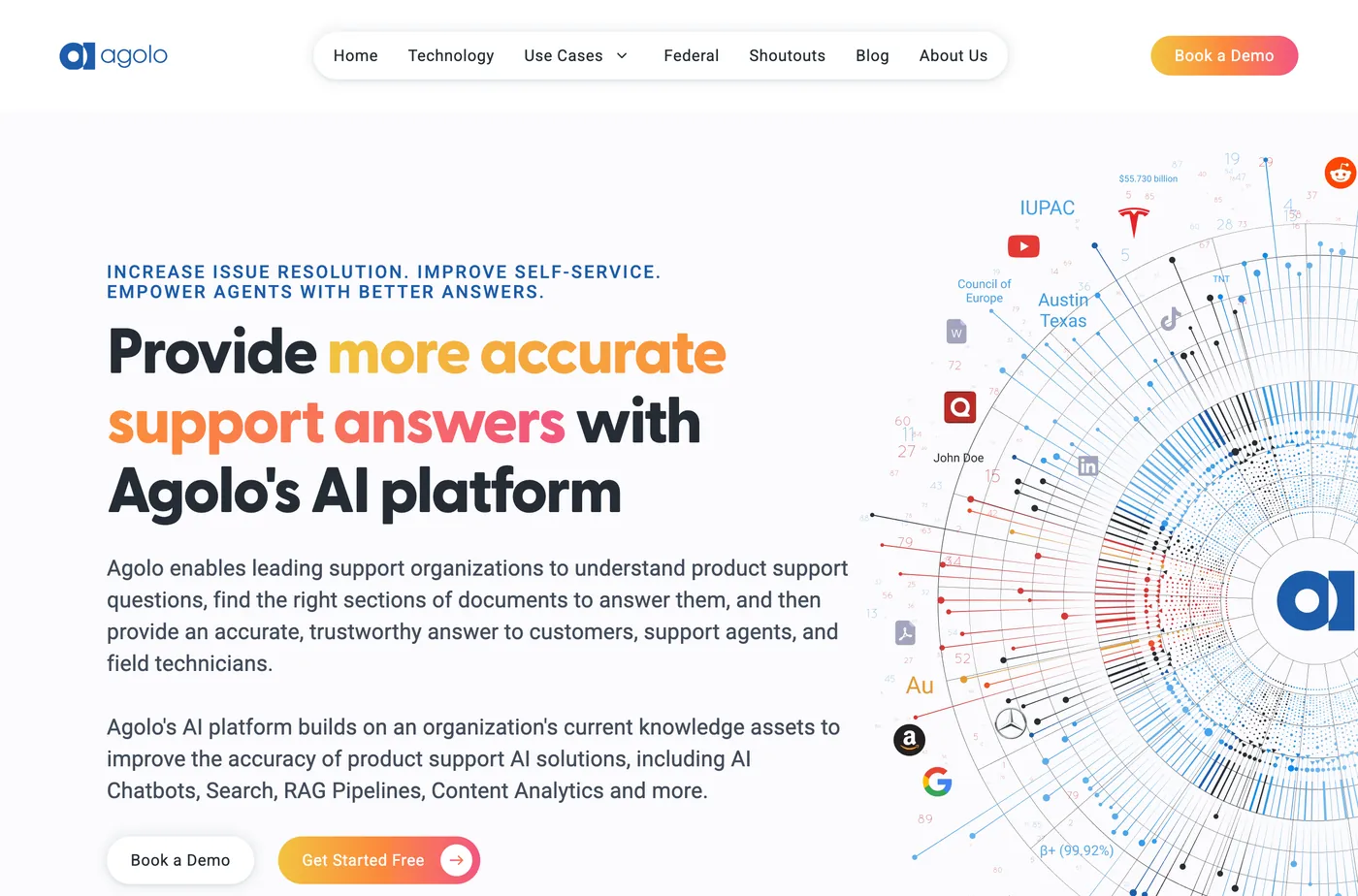
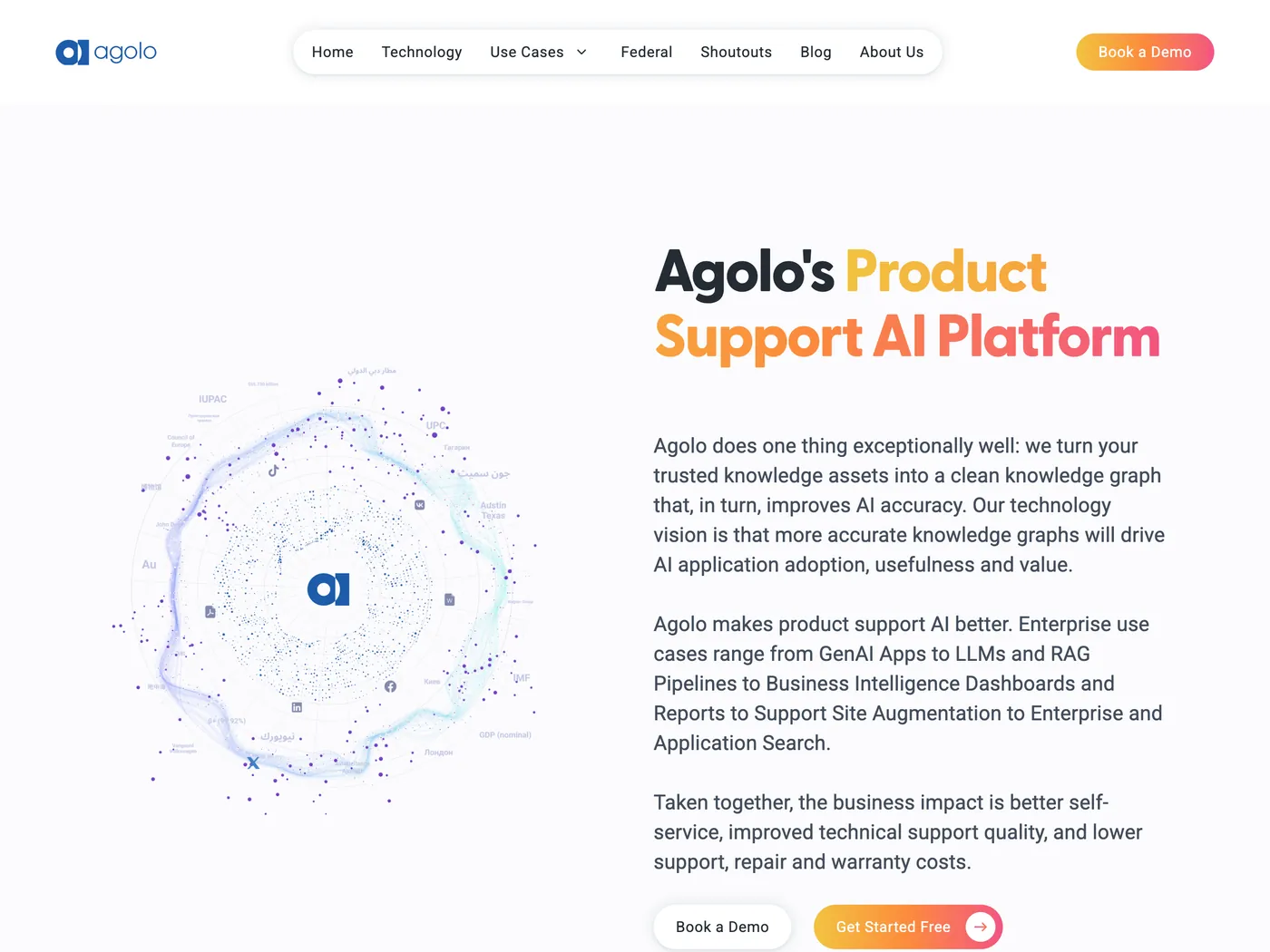
Agolo began as an NLP and AI research company doing entity extraction, pulling names, places, and things out of unstructured text. It then moved to selling GraphRAG infrastructure. The Agolo homepage offered to turn customers' trusted knowledge assets into a clean knowledge graph. The technology page listed GenAI apps, LLMs, RAG pipelines, and BI dashboards.
That copy confused a business buyer and pushed Agolo conversations to data science teams. Data science teams frequently wanted to build the infrastructure themselves, resulting in a sales process that required Agolo to sell against the very team they were trying to sell to.
In the meantime, the product could solve a real problem for support organizations, but the GTM messaging was aimed somewhere else entirely.
The decision
A new brand, because the old one still carried the old promise.
Agolo had years of accumulated recognition inside a technical audience. That recognition was the problem. The name was known by exactly the people who were never going to buy.
I drove the rebranding project, and worked through a long list of name candidates before landing on Implicit, then set the identity around it, the logo, the color system, the tone of voice, and the overall feel of the brand. Getting there meant aligning the CEO, the CTO, product, board members, and advisors on the same vision.
Colloquially, implicit knowledge is the expertise that never gets written down. It is what a technician knows that is not in the manual, and what a support agent learns on the job that no one ever documented. The new company name stated the very problem we aimed to solve.


The work
Three pivots, always getting closer to the mark.
Repositioning was not finished at launch. The site was rewritten three times over eighteen months, and every rewrite traded reach for a more qualified buyer.
v1Q1 2025
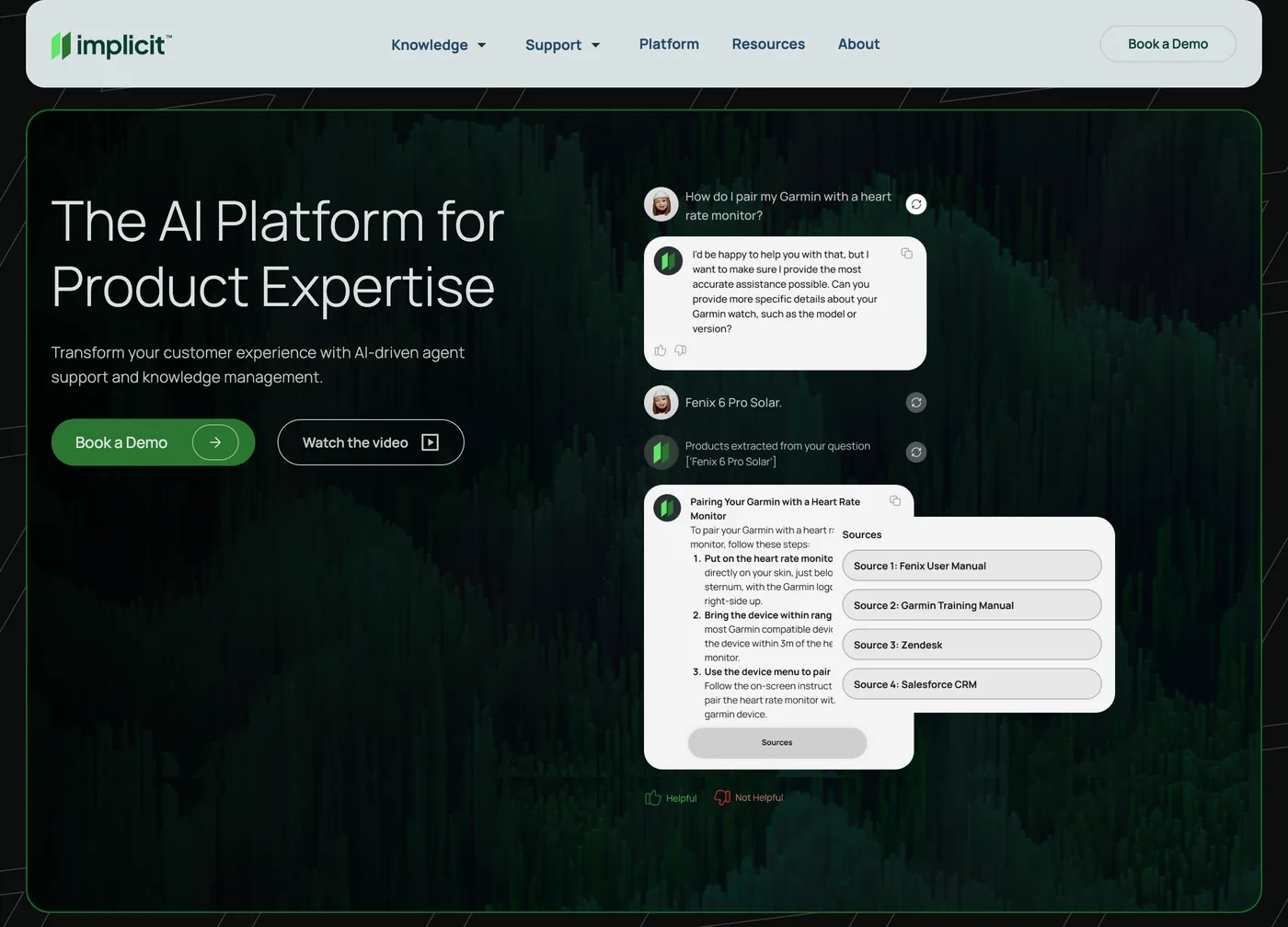
The AI Platform for Product Expertise
The first site under the new Implicit brand moved the core messaging from what the technology is to what it produces. The creative assets and proof points changed along with that messaging. An abstract graph diagram gave way to a real support conversation, answered with cited sources a reader could check.
It was still a platform, which is what you call a product before you have decided who it is for. Qualified leads increased from 1 the previous quarter as Agolo to 62 as Implicit, which said the direction was right, but the aim was still loose.
v2Q3 2025
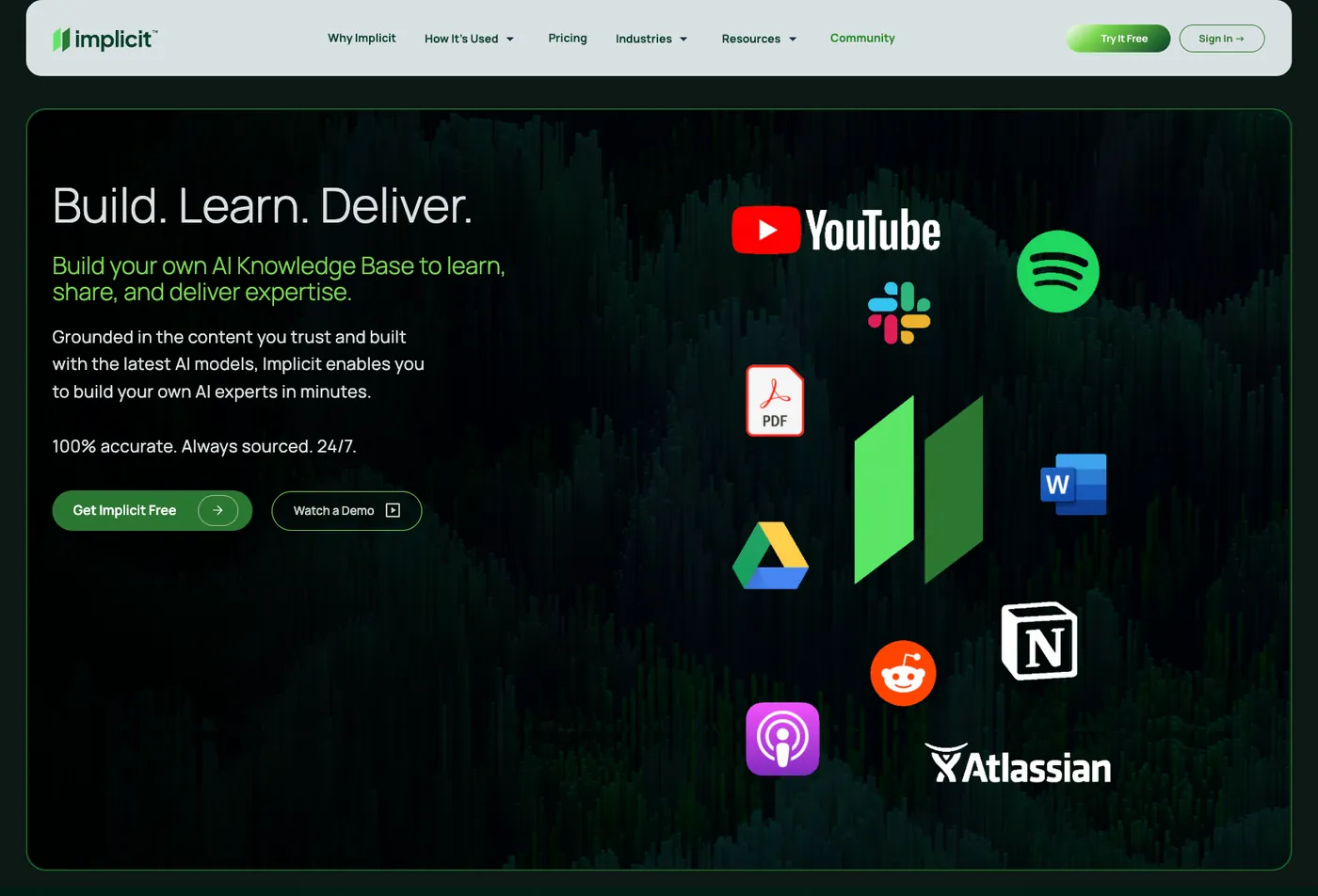
Build your own AI Knowledge Base to learn, share, and deliver expertise
The second rewrite on the messaging opened the product up to a broader audience. Try It Free CTAs replaced Book a Demo CTAs as the primary goal, pricing went public, and a community launched. The buyer became one person (or team) with a problem instead of a technical buying committee with a budget cycle.
The integrations listed on the page said everything about the ambition, with Drive, Notion, Slack, PDFs, and YouTube all treated as equal sources for a custom knowledge base. This is the version of the site that ran underneath the product-led growth program, accelerating lead generation and brand awareness significantly.
v3Q2 2026
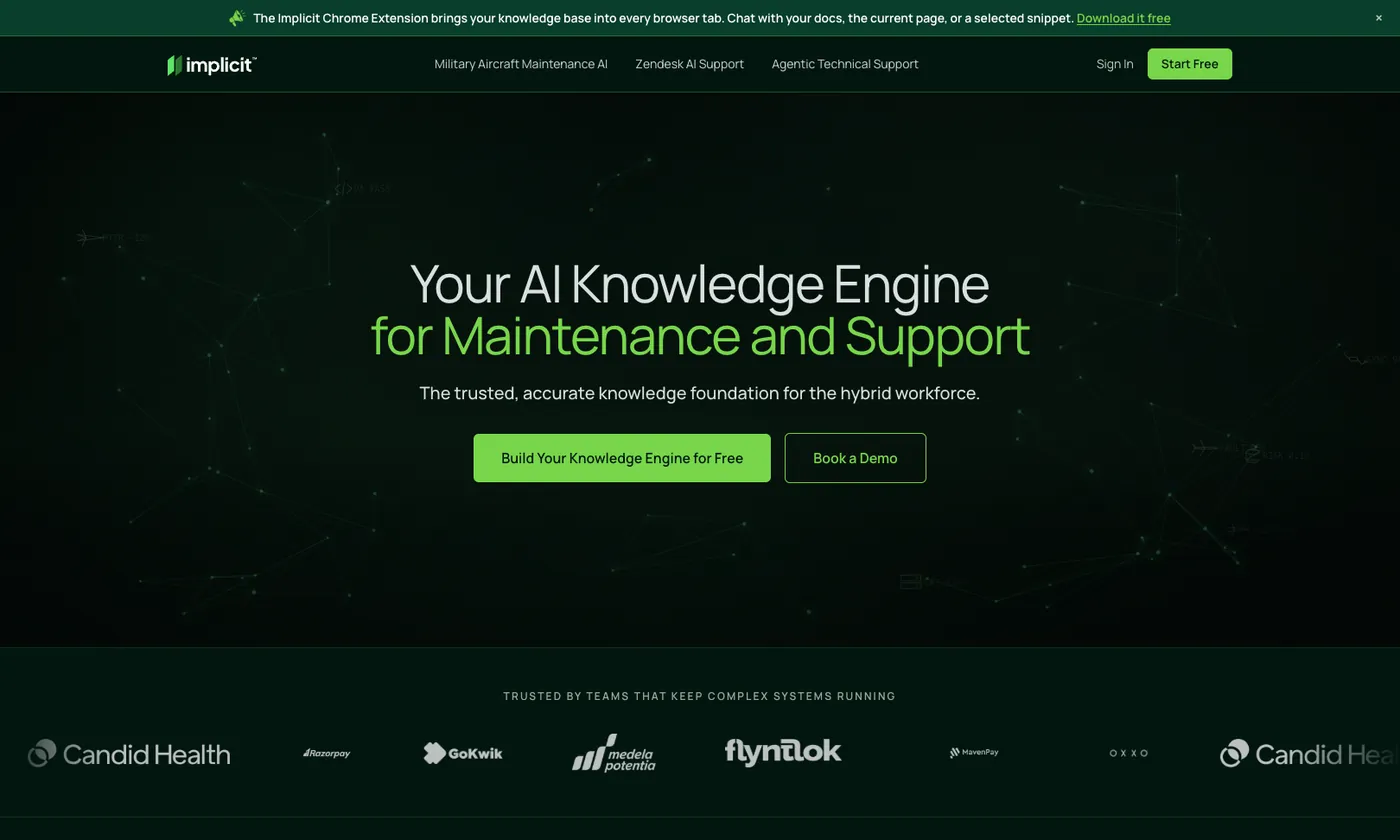
Your AI Knowledge Engine for Maintenance and Support
The third re-positioning was The Great Narrowing. The website navigation removed 8 use cases and 6 verticals, and instead listed specific customers, with Military Aircraft Maintenance AI, Zendesk AI Support, and Agentic Technical Support as the three doors into the site.
“Knowledge engine” became Implicit's category. The logos highlighted on the homepage shifted from tools and integrations to customers and social proof. The body copy stopped describing capabilities and features, and instead started describing how users could shift and improve their teams' workflows.
What happened
Steady growth out of a rebrand, testing, listening, and repositioning until it hit the mark at 1,133.
The first jump in qualified leads is the one worth noting. Nothing about the product changed between Q4 2024 and Q1 2025. The engineering roadmap did not ship a new capability, and the sales team did not grow. What changed was the name, the brand, the messaging, and positioning, and suddenly qualified leads increased from 1 to 62.
Q4 2025 came in slightly below Q3, which is what a plateau looks like when a position has been taken as far as it can go. The self-serve motion had found everyone it was going to find at that level of breadth. Growth resumed when freemium opened the top of the funnel in Q1 2026, and then more than doubled again in Q2.
The hard part
Three verticals in, five out.
The v3 positioning is defined by what it eliminates more than what it retains. Every segment that was eliminated could have conceivably produced revenue, which is exactly what makes them tempting (and dangerous).
Committed to
- Military aircraft maintenance and MRO. Rolling SBIR contracts already funded the work and kept renewing into new programs. The documentation problem is not in dispute, the cost of a wrong answer is not theoretical, and the buyer is used to paying for accuracy.
- Zendesk support teams. Chosen as a result of customer evidence rather than an aspirational vision. Customer feedback kept pointing to Zendesk, and traction showed up without being actively sought, so an integration was built to meet demand that already existed.
- Agentic technical support. The place where a cited, traceable answer is a requirement instead of a preference, which is the one thing the product does that a general assistant does not.
Ruled out
- Cybersecurity. Real budget and real urgency, and a category already crowded with vendors whose whole business is that one buyer.
- Product companies. Consumer hardware support at Garmin or Logitech scale. Attractive logos, and a support problem measured in volume rather than complexity.
- High-volume, low-complexity support. The deflection market. Whoever is cheapest wins it, and accuracy stops being the deciding factor.
- Product and engineering team use cases. The nearest neighbor to the old Agolo audience, and the fastest route back to competing with an internal build.
- Education, learning, and EdTech. A genuine fit for the technology, on a budget cycle and a sales motion that had nothing in common with the rest of the business.
Saying yes to all eight verticals was an available option, and we even tried it for a while. Lack of focus creates a diluted message and distracts from product market fit with your core audience. The three verticals we kept share a consistent trait. The answer has to be right, and someone can tell you what it costs when it is not.
The proof
From three knowledge bases to one source agents trust.
Expedition, the umbrella company formed from the merger of Rezdy, Checkfront, and Regiondo, ran three legacy support systems at once across three continents.
3
Legacy support systems unified into one governed knowledge layer.
600+
Articles loaded into the first Implicit knowledge base.
6
Languages in active use across the support organization.
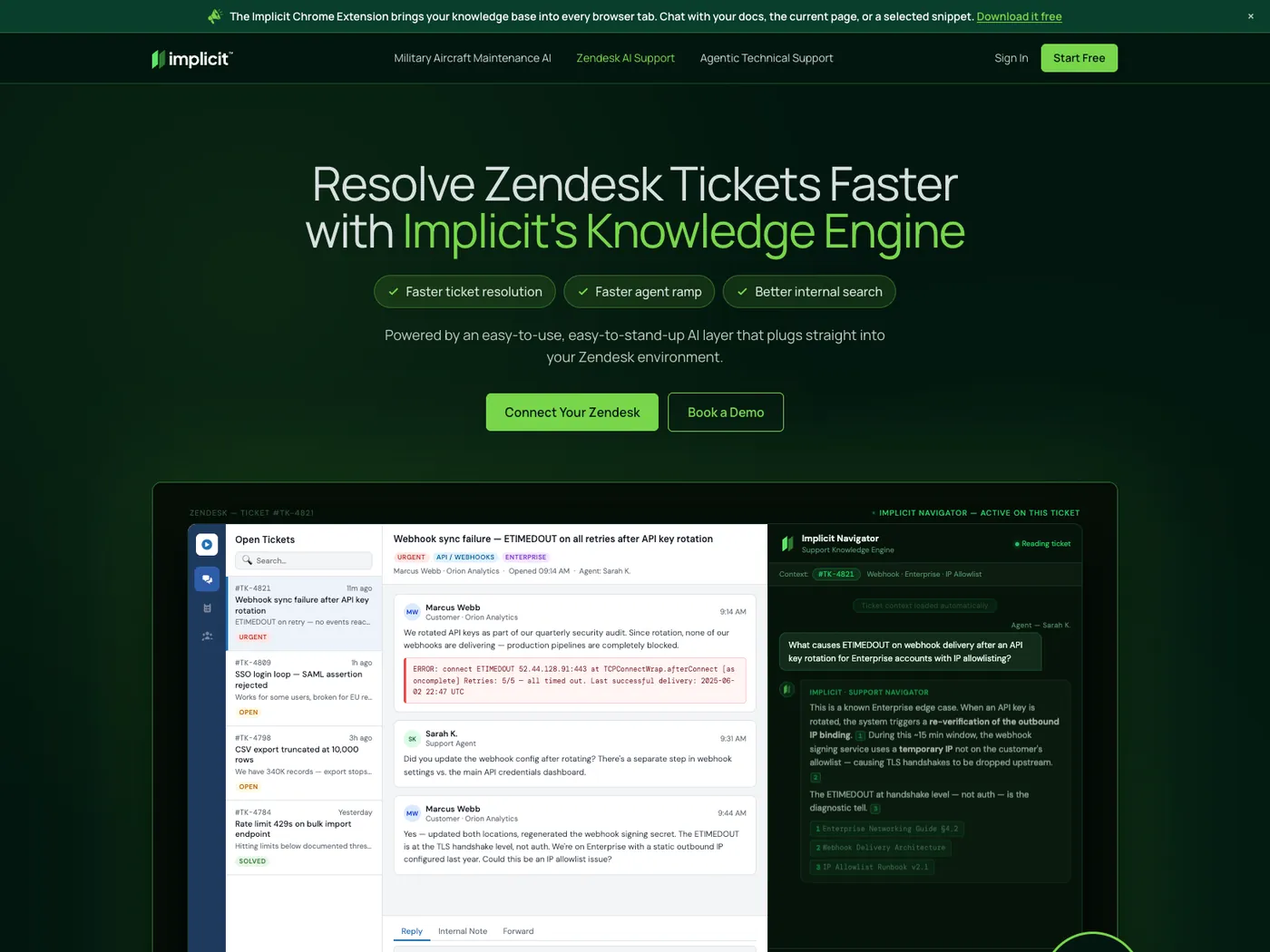
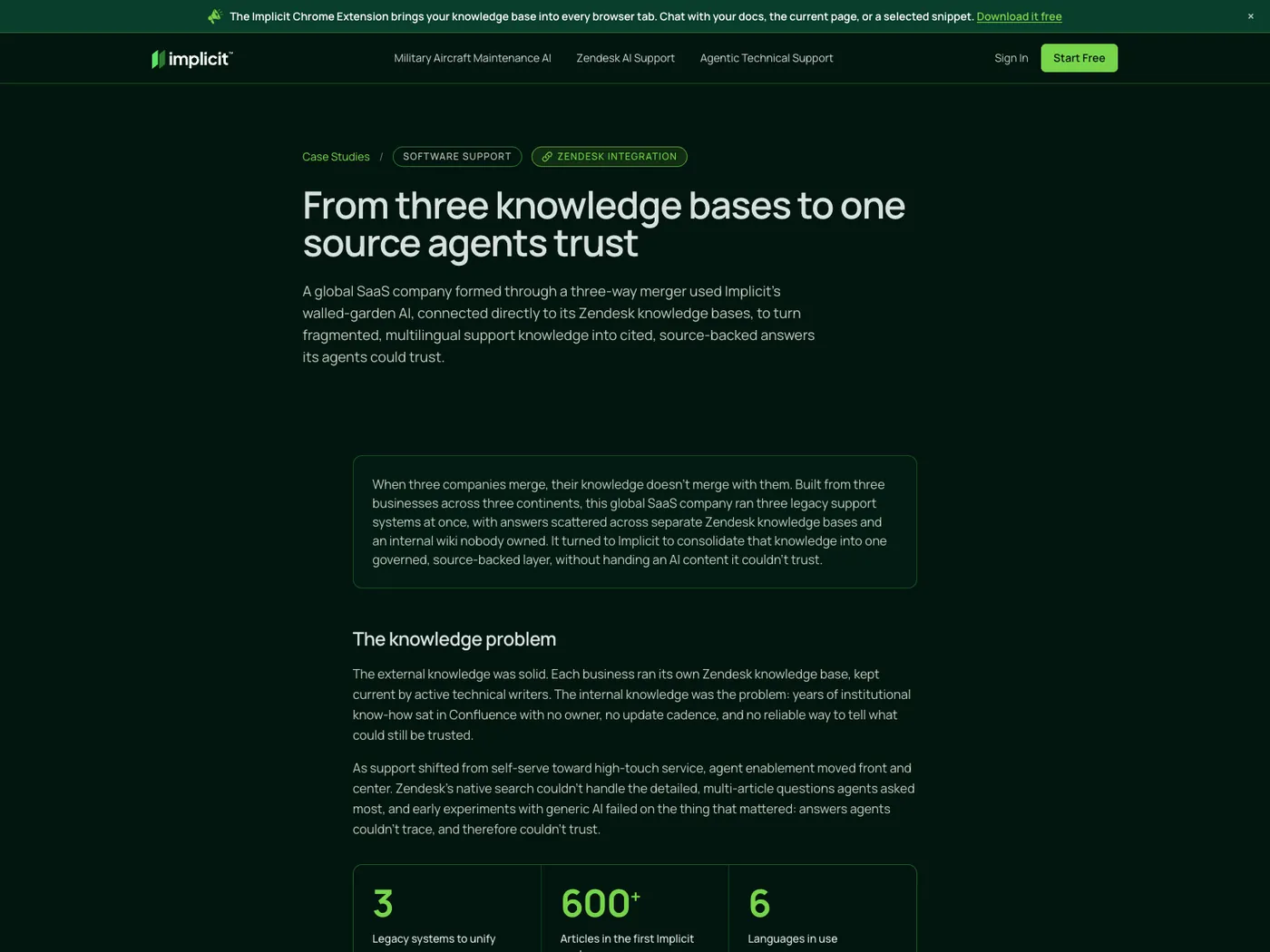
The external knowledge was in good shape, with each business running its own knowledge base kept current. Internal knowledge was where it broke down. Years of institutional know-how sat in Confluence with no owner, no update cadence, and no reliable way to tell what could still be trusted. Generic AI failed on producing answers agents could trace, and therefore could not trust and would not use.
This story is only tellable because of the narrowing in Implicit's positioning. In the mind of the buyer, a company positioned as a general knowledge platform doesn't solve the same problem as a knowledge engine for maintenance and support.
The results
18 months, 2 brands, 4 positions, and we finally hit the mark.
-
1,133
Qualified leads in Q2 2026, against one in the final quarter as Agolo.
-
62
Qualified leads in the first full quarter as Implicit, with no change to the product behind it.
-
3
Verticals committed to, chosen from eight and defended against the other five.
-
100%
Share of commercial customers won under the new position.
What came next
The new position made the demand program possible.
Answer engine optimization and community marketing both depend on a company describing a problem in the same words its buyers use, answering the questions they ask about the frustrations they are experiencing.
Once the words on Implicit's website matched the issues buyers were living, a demand program had something to work with. That program is written up separately in Implicit Product-Led Growth from Zero, which covers the six months from January to June 2026 and the 2,500 users it produced.